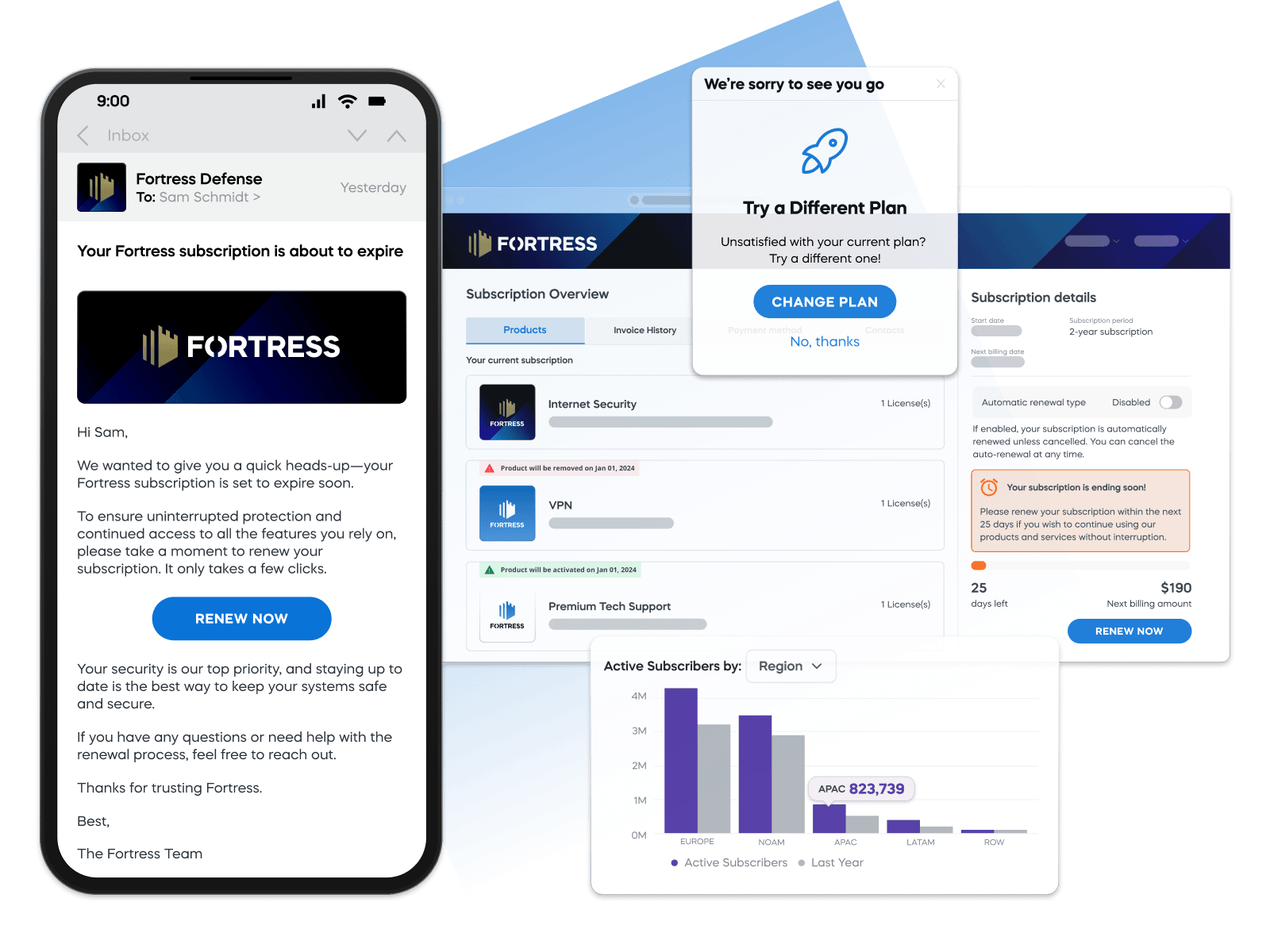
As more revenue becomes routine, software companies are rethinking how sales, customer success, and digital buying paths work together.
Written by

Share this post
Subscribe for best practices on optimizing your software business.
Listen to this article
- Sales-led models still work — just not for everything
- The mismatch between transaction types and sales motions
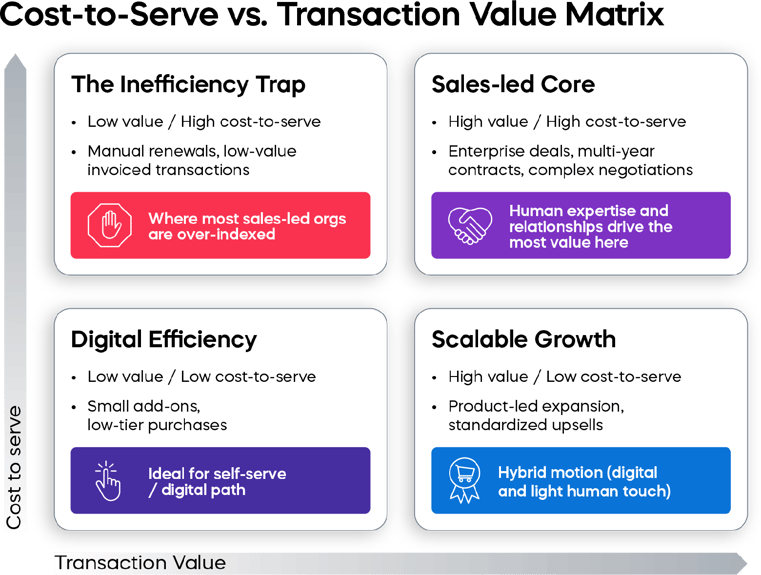
- The cost-to-serve equation is hard to ignore
- Sales teams lack unlimited capacity
- Why static segmentation no longer works
- Why sales-led organizations are shifting now
- How leading companies are introducing digital buying paths
- The shift is strategic — but the risks are real
- Bottom line
- FAQs
As more revenue becomes routine, software companies are rethinking how sales, customer success, and digital buying paths work together.

This is the second installment in a new series exploring the future of software selling. (To read our third installment on partner-led organizations, click here.) In the coming months, we’ll also share original research examining how software companies go to market today, the economics behind those models, and what it takes to support more scalable digital and hybrid revenue motions.
In the first entry of this series, we discussed a shift already underway in enterprise software: companies are building digital buying paths to handle more of their revenue motion.
And for many businesses, it's no longer a secondary model. McKinsey reports that for organizations offering digital commerce, it now generates more than one-third of revenue — overtaking in-person sales as the top revenue-generating channel.
There's good reason for that.
Enterprise sales organizations are built to win complex, high-value deals. They are not built to handle the mountains of administrative work that come with renewals, add-ons, quoting and other routine transactions — work that often spans sales, customer success, and account management teams, and represents an increasing share of revenue.
This isn’t a failure of the sales model. It’s a mismatch between how revenue is generated and how it’s being handled. And enterprise software companies are redesigning their GTM motions around that reality.
It’s worth stating clearly: sales-led go-to-market models are not going away, even as AI and automation reshape parts of the buying journey. The shift is about where human involvement creates the most value.
Sales-led organizations were built around the realities of complex enterprise buying, with specialized teams supporting different stages of the customer lifecycle. They generate demand through prospecting and relationship-building. They coordinate complex buying cycles across procurement, finance, legal, IT, and executive stakeholders. They negotiate custom pricing, terms, and contracts. And they help large organizations navigate purchases that can take months — or longer — to close.
That model still works extremely well in the right context. Enterprise software companies continue to rely on sales-led motions for high-ACV opportunities and multi-year contracts, as well as strategic expansions and/or renewals. In these environments, human involvement is a competitive advantage.
And for a long time, the economics supported that structure. Enterprise software buying was defined by long sales cycles, heavy customization, and procurement-led decision-making. As a result, organizations scaled around that reality: larger sales teams, broader territory coverage, and increasingly specialized GTM roles.
What has changed is the mix of transactions flowing through enterprise sales organizations. Today, the same business that closes a $500K enterprise deal is also spending an abundance of time closing a $5K deal, or processing a $10K renewal, a mid-cycle add-on, a seat expansion — often through similarly high-touch workflows.
That’s where the model starts to break down.
It’s evident that too many routine transactions are being processed through sales motions designed for far more complex enterprise deals.
A buyer renewing an annual subscription or purchasing an add-on doesn’t necessarily want the same process as a company evaluating a multi-year enterprise agreement. And yet, in many organizations, both are still routed through the same workflows, systems, and teams.
That creates friction on both sides. Sales and client success teams spend time on transactions that don’t require high-touch engagement, while buyers encounter unnecessary delays for relatively straightforward purchases.
According to McKinsey, 86% of B2B buyers prefer using self-service tools for reordering over speaking to a sales rep. That doesn’t mean buyers no longer value sales involvement. It means the more routine transactions increasingly benefit from faster, lower-friction buying paths — especially when little negotiation or coordination is required.
Most enterprise sales organizations already segment coverage by account size and complexity. What’s changing is the level of segmentation happening within those accounts, as companies rethink which transactions truly require high-touch engagement and which are better suited for digital or hybrid motions.
The cost-to-serve equation is hard to ignore
Once sales capacity becomes more selective, the next question is how that capacity should be applied.
That brings cost-to-serve into focus.
Every transaction carries an operating cost: sales time, quoting, approvals, invoicing, payment collection, customer coordination, and internal handoffs. For a complex enterprise deal, those costs may be justified by the size and strategic value of the opportunity. For routine deals like a small add-on, the same process can quickly erode margin and slow down the buyer.
This is where the economics of scale become clearer. TSIA benchmark data shows that digital-touch customer success models support dramatically more accounts per CSM than high-touch models, underscoring how digital workflows can reduce cost-to-serve across renewals, expansions, and other routine customer transactions.
Ultimately, the problem isn’t just sales teams being tasked with transactions that don’t require their touch. It’s that the mismatch creates margin pressure and operational drag by applying costly motions to relatively low-value transactions.
Sales teams lack unlimited capacity
Even highly effective sales organizations face a scaling challenge when routine transactions consume time, coordination, and operational resources.
In fact, Salesforce reports that sales reps spend just 28% of their week actually selling, with the rest consumed by administrative and other non-selling work. That broader productivity issue deserves attention on its own, but it also highlights an important limitation of sales-led models: human capacity does not scale infinitely.
Digital buying paths change the equation because they operate as always-on systems to supplement human-dependent workflows. They do not eliminate the need for sales involvement in complex deals, but they reduce the operational burden tied to routine transactions that buyers increasingly expect to complete quickly and independently.
Without digital workflows to support routine transactions, many organizations struggle to scale renewals, add-ons, and lower-complexity purchases efficiently — increasing the risk of churn, missed revenue, and poor customer experiences.
Why static segmentation no longer works
Enterprise software companies already segment customers by categories like account value, complexity, geography, and vertical. What’s changing is how transactions within those accounts are being handled.
Most sales-led organizations still segment customers primarily by account size — enterprise, mid-market, SMB — with the assumption that larger accounts require high-touch engagement while smaller accounts can be handled more efficiently.
But transactions don’t behave that neatly anymore.
A single enterprise customer may generate:
- a complex multi-year expansion requiring executive alignment
- a straightforward renewal
- a simple seat increase
- a low-friction add-on purchase
Routing all of those motions through the same process no longer makes operational or financial sense.
The inverse is also true. Smaller accounts are not always “simple.” Some require disproportionate support, while others have significant expansion potential over time.
Contract value alone is no longer a reliable indicator of either complexity or revenue opportunity. In a recent GTMnow interview, then Sophos Chief Customer Officer Teresa Anania admitted how even enterprise customers require different engagement models depending on the type of interaction — reinforcing the idea that transaction complexity, not just account tier, increasingly determines where human involvement adds value.
As a result, leading companies are starting to segment differently — not just by customer, but by transaction. Instead of asking:
“What tier is this account?”
They are increasingly asking:
“What level of involvement does this transaction actually require?”
This shift is being driven by more than buyer preference alone.
Expansion revenue now represents an increasing share of SaaS growth, while acquiring new customers continues to become more expensive. That places increasing pressure on organizations to capture more value from existing accounts — without scaling operating costs at the same pace.
Finance leaders are feeling the pressure as well. Cost-to-serve, margin discipline, and operational efficiency are receiving far more scrutiny than they did during the growth-at-all-costs era. The broader push toward automation and AI-enabled workflows reflects the same underlying reality: companies need more leverage from their existing systems and teams.
And while we’re still in the early stages of agentic commerce, software sellers still need structured digital transaction paths before AI-assisted buying can move reliably move from discovery to purchase.
At the same time, global growth adds another layer of complexity. In The Friction Report, 83% of software sellers said global expansion is a priority. Yet many sales-led organizations struggle to support large customer books across regions through purely manual workflows. Languages, payment preferences, and local purchasing norms all vary — but become much easier to manage when quoting, invoicing, payment processing, subscription management, and renewals occur through centralized digital paths.
All of this is accelerating the move toward digital buying paths — a shift driven by operational, economic, and market factors.
The companies getting this right are not trying to digitize every transaction overnight.
Instead, they are starting with high-volume, low-complexity motions that create operational drag when handled manually.
Renewals are often the first place this happens. Cyncly, for example, eliminated 7,000 manual monthly renewals after introducing a digital approach, exposing how much operational work can sit behind “routine” revenue.
From there, many organizations expand into add-ons, seat expansions, and smaller purchases — gradually building parallel buying paths that complement existing sales motions.
In practice, these models typically evolve in stages. Some organizations introduce fully self-service transactions for routine purchases. Others adopt hybrid workflows, where sales initiates the transaction, but the customer completes it digitally through CPQ and checkout flows.
More mature organizations often build parallel paths — giving customers the flexibility to buy digitally or involve a sales rep when additional guidance or negotiation is needed.
The structure varies from company to company. The underlying principle does not: align the transaction to the motion best equipped to handle it efficiently.
This transition is not without challenges.
Sales teams may worry about compensation or loss of control. Poor segmentation can push the wrong transactions into digital workflows, while weak user experiences can limit adoption altogether.
But these are implementation challenges — not arguments against the model itself.
The organizations succeeding here tend to share a few characteristics. They define clear routing rules, align incentives across teams, and start with focused transaction types rather than broad transformation efforts.
Most importantly, they treat digital buying as a core part of their go-to-market — not a side initiative.
Sales-led models are not disappearing. But they are evolving around a very different mix of transactions than the ones they were originally built to support.
The question is no longer whether digital buying belongs in enterprise software. It already does.
The real question is how organizations segment and route transactions across sales-led, digital, and hybrid motions — and whether they can do it in a way that improves both buyer experience and operational efficiency.
The companies that balance that successfully will be far better positioned to scale expansion revenue, reduce cost-to-serve, and adapt to the next phase of enterprise software buying.
Does introducing digital buying paths mean replacing sales reps?
No. The goal is to route different transaction types through the most appropriate motion. Complex enterprise deals, strategic expansions, and multi-stakeholder negotiations still benefit from high-touch sales engagement. Digital buying paths are typically introduced for lower-complexity transactions like renewals, add-ons, and smaller purchases that don’t require the same level of human involvement.
Won’t self-service reduce deal sizes or hurt expansion opportunities?
Not necessarily. In many organizations, digital buying paths actually help capture expansion revenue that would otherwise be delayed, deprioritized, or missed entirely. The key is segmentation. High-complexity or strategic expansions can still route to sales or customer success, while routine transactions move through lower-friction digital or hybrid paths.
What transactions usually move to digital first?
Most companies begin with high-volume, lower-complexity transactions that create operational drag when handled manually. Renewals are often the starting point, as well as seat expansions, add-ons, smaller repeat purchases, and standardized upsells. These motions typically don’t require extensive negotiation or stakeholder coordination, but they can consume significant sales and operational resources when processed through traditional workflows.
How do you know when your organization is ready for this shift?
The shift usually becomes necessary when the economics of the existing sales motion start to break down. Common signs include sales teams spending too much time on low-value transactions, increasing operational complexity around renewals and invoicing, growing dependence on expansion revenue, and pressure to improve margins without scaling headcount linearly.
What do software companies often misunderstand about digital buying paths?
Many organizations initially think of digital commerce as simply adding online checkout functionality. In practice, the operational challenge is much broader. Renewals, quoting, invoicing, payment processing, subscription management, entitlement, localization, and post-purchase workflows all influence how efficiently routine revenue can scale. Companies that treat digital buying as a standalone commerce feature often struggle to reduce friction across the full customer lifecycle, especially as transaction volume and global complexity increase.