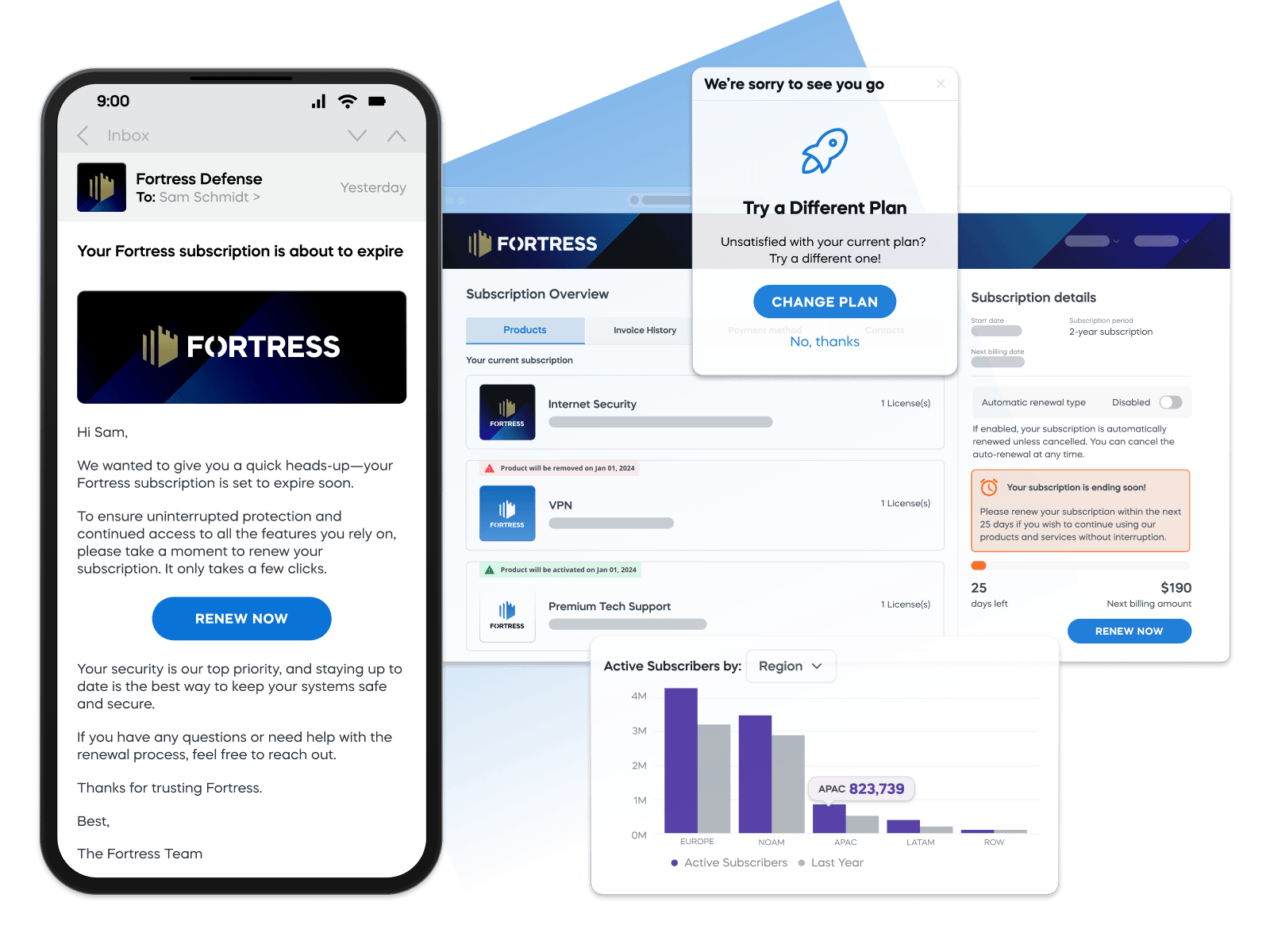
How buyer behavior, margin pressure, and operational complexity are reshaping go-to-market models.
Written by

Share this post
Subscribe for best practices on optimizing your software business.
Listen to this article
How buyer behavior, margin pressure, and operational complexity are reshaping go-to-market models.

This is the first installment in a new series on the future of software selling. (Click here to read the second installment on sales-led organizations and here to read the third installment on partner-led organizations.) In the coming months, we’ll also share original research to help quantify where friction exists today across the customer lifecycle, and what it will take for companies to evolve beyond traditional models.
For years, enterprise software growth has been powered by sales teams and partner ecosystems. These models still play a critical role in handling complex deals, strategic accounts, and long-term relationships, and for many organizations they remain the backbone of revenue generation.
But a shift is underway — driven not just by internal pressures, but by changing customer preference.
As more revenue flows through renewals, add-ons, and upsells, leadership teams are reassessing how those transactions are covered.
Across the software market, many vendors still rely on manual, sales-assisted, or partner-led models for a meaningful share of these transactions. That creates margin pressure, high cost-to-serve, limited customer data visibility, operational complexity, and inconsistent buyer experiences.
What’s emerging, however, is not a rejection of sales or partners, but an evolution of the go-to-market mix.
Leading B2B software companies are introducing a self-serve digital buying path alongside their existing motions — one designed to handle routine transactions at scale, improve unit economics, and regain control over underserved revenue, all while delivering customers a more consistent and predictable buying experience.
For a growing number of enterprise businesses, this shift is already delivering measurable impact — not just by introducing digital touchpoints, but by driving broader organizational change that aligns how teams operate with how customers actually want to buy.
Just as importantly, this shift lays the groundwork for what comes next: AI-driven and agentic commerce models that depend on clean, unified data to function effectively. Gartner predicts that 90% of B2B buying will be intermediated by AI agents as soon as 2028, underscoring how quickly these models are becoming a practical reality.
The trends we're seeing in the market
In conversations with CFOs, revenue leaders, and channel teams, a consistent pattern keeps emerging: while companies are reevaluating their go-to-market mix for a range of reasons (e.g., margin pressure), the decisions are increasingly being shaped by a fundamental shift in buying behavior.
Today, 67% of B2B buyers prefer a rep-free buying experience, yet many GTM models haven’t caught up. Digital purchasing is no longer limited to B2C or SMB use cases. A significant share of B2B revenue is already completed through digital channels — 56% up from 32% in 2020 — and that number continues to grow.
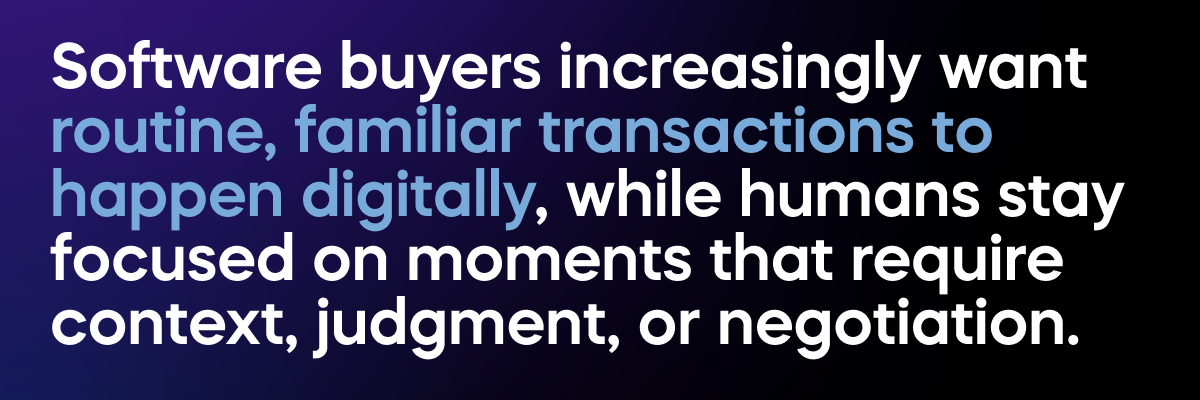
This doesn’t mean the role of sales or partners is diminishing. It means the expectation of optionality is increasing. Buyers want:
- The ability to self-serve when the purchase is straightforward
- Clear pricing and fast, frictionless transactions
- The option to involve a human when complexity arises
For companies without a digital path, the gaps show up quickly: routine transactions get forced through high-touch workflows; renewals are delayed, inconsistent, or manually driven; and global transactions incur friction around payments, tax, and compliance.
Beyond what’s already breaking, companies are also reckoning with an impending shift: their current models aren’t designed for how software will be bought and sold in the coming years. As buying becomes more autonomous — from AI-assisted product discovery to purchase-in-chat experiences — a strong digital foundation becomes table stakes.
Why this matters to your business (and the hidden cost of inaction)
The cost of ignoring this shift is already visible in unit economics — and it compounds over time. When every transaction is forced through sales or partners:
-
Cost to serve becomes disproportionately high for routine transactions
-
Sales reps and partners prioritize large deals and neglect smaller transactions
-
Certain renewals can get delayed, discounted, or missed entirely
-
Add-on and upgrade opportunities are neglected at opportune moments
-
Customer experience becomes inconsistent across segments
-
Transactions take longer to close, delaying cash collection
These inefficiencies are becoming more consequential as the composition of revenue changes. Customer expansion (i.e., growing business through upsells, cross-sells, add-ons, etc.) now accounts for 40% of new annual recurring revenue (ARR).
As companies focus more on lifetime value, expansion depends on accessibility. When add-ons and upgrades require sales involvement or lengthy procurement, customers are less likely to act — not due to lack of demand, but because the path to purchase is too slow or cumbersome. (Forrester reports that 86% of B2B transactions stall at the point of sale.) Companies need low-friction paths that allow customers to expand on their own terms, at any point in the lifecycle.
Also, while many CFOs are willing to sacrifice margin to win strategic deals or logos, the same logic does not apply for routine transactions.
What’s changed is scale.
As businesses expand globally, add products, and diversify customer segments, the volume of routine, low-complexity transactions grows. Without a digital path, those transactions absorb time, budget, and operational capacity that could be better spent elsewhere.
This is why finance teams are increasingly driving the shift toward digital buying. Traditional models weren’t built to handle high volumes of low-complexity transactions — and the cost is significant. In some cases, Cleverbridge clients have seen margin improvements of up to 30 points after moving routine transactions to digital paths.
Why traditional sales and partner models break down on routine transactions
At a high level, the shift to digital or hybrid selling is about coverage: which transactions require high-touch engagement, and which are better suited for self-serve?
This question shows up across both traditional sales-led teams and partner-led organizations. Both models deliver real value. Both also struggle in predictable ways when they’re asked to cover transactions they weren’t meant for.
In sales-led organizations
In sales-led businesses, the issue is misallocation. Sales teams are ideal for complex, high-value deals that require context, judgement, and negotiation — not basic renewals or repeat purchases. Furthermore, a lot of their time is pulled into lower-value work. Salesforce reports that most reps spend only 28% of their week actually selling, while the other 72% is consumed by admin and other tasks.
This is a clear indicator that always-on, digital sales channels fill a massive gap. When lower-value transactions are routed through high-cost, human-led sales coverage, cost-to-serve becomes disproportionate and margins erode.
In channel-led organizations
In channel-led models, the issues are ownership and economic alignment. Partners are highly effective at extending reach and driving distribution; more than 70% of B2B tech revenue flows through indirect channels, whether it’s a traditional channel partner or a cloud-based marketplace like that from Amazon Web Services (AWS).
The issue is partners are typically incentivized to go after larger, higher-value opportunities. For lower-value or repeat transactions, on the other hand, partner margins and take rates can put a strain on unit economics.
For both sales-rep and channel-led businesses, the outcome is typically the same: a growing portion of revenue is underserved, and profit takes a hit.
It also creates a data challenge. When transactions are fragmented across sales, partners, and manual processes, it becomes difficult to generate the consistent, high-quality insights needed to improve performance — or to support more advanced, AI-driven optimization over time.
This is why many CFOs and business leaders are now rethinking how coverage is structured — not by replacing existing models, but by introducing a more efficient path for repeatable, lower-complexity transactions that are currently marginalized by sales teams and partners.
Introducing the digital buying path
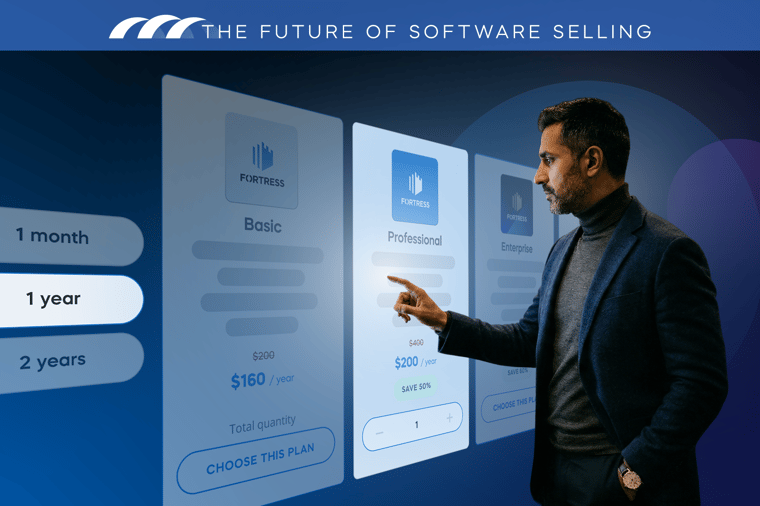
A digital buying path works alongside sales teams and partners by enabling a dedicated, self-serve checkout for routine transactions — one designed for flexibility and scale — while preserving high-touch engagement for where it adds the most value.
Routine transactions are repeatable, lower-complexity purchases — renewals, add-ons, mid-term upgrades, cross-sells, and smaller new orders — that can usually be completed without custom terms, complex approvals, or high-touch sales involvement.
In practice, these moments show up everywhere: a customer in Brazil renewing a subscription in local currency, a team in Japan looking to add seats quote-free, or a US business upgrading mid-cycle to unlock more functionality. These are simple transactions, but without a digital path, they often become unnecessarily complex.
When these experiences are streamlined, the impact shows up quickly. Across the Cleverbridge client base, we’ve seen an average 1–3% increase in renewal rates in customer segments that moved to digital buying paths — driven in large part by improved accessibility and a better overall buying experience.
These are buying moments where customers value speed, clarity, and autonomy — not the ability to negotiate terms.
A digital buying path operationalizes go-to-market models by introducing a clearer separation of responsibilities. Sales teams focus on complex, high-value opportunities, while partners drive distribution and strategic value. Digital handles repeatable, lower-complexity transactions at scale — and can also support sales and partners through hybrid motions (e.g., streamlining transactions via tools like CPQ workflows, embedded checkouts, or storefronts).
Just as importantly, this creates a unified, structured data layer across transactions — enabling cleaner visibility into customer behavior, pricing, and lifecycle activity. That foundation is critical for supporting AI-driven commerce, from automated lifecycle workflows to more advanced, agentic buying experiences.
The result is a more balanced GTM system — one that grows without adding friction, captures long-tail revenue more effectively, and improves visibility across the customer lifecycle.
An enterprise example: How PTC closed its digital buying gap
PTC’s story offers a clear view of what this shift looks like inside a mature enterprise software company. Facing growing demand from high-intent customers for more straightforward transactions — renewals, seat expansions, smaller purchases — the existing process couldn’t keep up.
According to Megan Henf, VP of Digital Transformation at PTC, what should have been a simple process often turned into an endless loop of quoting, approvals, and handoffs, creating friction around revenue that should have been easy to capture. As such, PTC focused on rebuilding its GTM foundation by simplifying how customers buy and standardizing what should be consistent.
In practice, this meant more than adding online checkout. PTC reworked the underlying mechanics of how transactions flow — from pricing and approvals to renewals and global requirements — while introducing clearer segmentation around which transactions should move through digital versus sales or partner-led paths.
The result was a more disciplined hybrid model: routine, high-volume transactions moved through a streamlined digital experience, while higher-value or more complex scenarios continued to involve human engagement.
The outcomes were directionally consistent with what many teams see when they get this right: improved unit economics, more predictable growth, faster quote-to-cash, and renewals that could scale.
The broader lesson is that digital is not meant to be disruptive. “We did a lot to help our partners and sellers understand that this is additive,” said Henf, regarding the organizational change component.
As was the case with PTC, the goal isn’t to replace sales or partner-led motions, but to complement them — creating a more efficient path for routine transactions while preserving high-touch engagement where it matters most. The result is a more scalable and balanced go-to-market model.
Bottom line
The shift to digital buying is already reshaping how software companies structure coverage, allocate resources, and capture revenue across the customer lifecycle.
It’s also accelerating. As AI becomes more embedded in how software is discovered, evaluated, and purchased, it becomes more than just a channel shift — it’s a structural change in how revenue is generated. The question isn’t whether this is happening, but how your business will respond to it.
The rising tide is also not limited to routine, low-value transactions. According to McKinsey, 73% of B2B buyers are willing to spend more than $50,000 through self-service or remote channels, while 39% would spend more than $500,000 and 20% are comfortable spending over $1 million.
So the more immediate question becomes: where is your current model creating friction, inefficiency, or missed opportunity — and what is it actually costing the business?
In the next articles, we’ll look at how this transformation plays out across sales-led and partner-led organizations — from where traditional coverage models start to break down, to how leading teams are introducing digital paths without disrupting what already works.
And if you’re already rethinking stuff like customer segmentation, servicing models, or how to better align cost-to-serve with transaction value — we can help.
Companies like PTC, Sophos, and SUSE, are using Cleverbridge to move routine transactions into digital, buyer-friendly paths, while preserving high-touch resources for where they matter most.
FAQs
How do you decide which transactions should move to digital first?
Start with transactions that are repeatable, low in complexity, and expensive to handle manually. For most B2B software businesses, that includes renewals, add-ons, seat expansions, mid-term upgrades, cross-sells, and smaller new orders that do not require custom terms or complex approvals. The goal is not to digitize everything at once, but to prioritize transactions where speed, consistency, and lower cost-to-serve matter most, all while aligning with growing buyer expectations.
When should a transaction remain sales-led instead of moving to digital?
A transaction should usually stay sales-led when it involves custom pricing, complex approvals, negotiated terms, multiple stakeholders, or strategic account planning. Digital buying works best when the purchase is clear, repeatable, and low in complexity — like renewals, add-ons, seat expansions, or mid-term upgrades.
How can digital buying support direct sales and partner-led sales?
A digital buying path works best when it gives customers choice in how they want to transact, whether it’s through self-serve, sales reps, or partners. When customers opt to complete routine purchases digitally, sales reps and partners have more time to focus on larger, more strategic opportunities. Digital buying can also support hybrid motions through digital storefronts and personalized checkouts links, which enable reps and partners to process repeatable transactions more efficiently while still maintaining the customer relationship.
Does digital buying only matter for low-value transactions?
Not necessarily. Many software companies begin by routing lower-value, routine transactions to digital buying paths, but that is usually a starting point, not a limit. B2B buyers are increasingly willing to complete larger purchases digitally when the process is straightforward and supports familiar payment options like invoice, purchase order, or wire transfer. In practice, the better guide is not dollar value alone, but whether the transaction can be completed without heavy negotiation or complex approvals.
Why does digital buying matter for AI-driven commerce?
Digital buying creates cleaner, more consistent transaction data across the customer lifecycle. That matters because AI-assisted buying, automated lifecycle workflows, and future agentic commerce all depend on structured, reliable data to work well. Simply put, a digital buying path is table stakes as far as the operational foundation for how software will increasingly be bought and sold.
Is digital buying only relevant for enterprise software companies?
No. A large long tail can make the value of digital buying more obvious, but it is not a requirement. Digital buying supports new purchases, expansions, and renewals alike — anywhere a lower-friction, lower-cost path makes sense. Enterprise software companies often see the biggest margin gains once they have a large install base and more routine revenue to manage, while smaller businesses may benefit earlier by using digital buying to acquire customers more efficiently and build for scale from the start.