Read the second entry in our new series: Making AI Agents Work in High Stakes Environments

Written by

Share this post
Subscribe for best practices on optimizing your software business.
Listen to this article
Read the second entry in our new series: Making AI Agents Work in High Stakes Environments
TL;DR: Agentic commerce, where agents conduct transactions on behalf of customers, is moving from concept to reality. The immediate impact is on discovery (zero-click searches), but the true disruption lies in autonomous purchasing. Preparation isn't about futuristic hype; it's about immediate infrastructure choices (like payment tokenization), a content strategy for non-human customers, and redesigning business models before agents become the new gatekeepers of commerce.
Early days, rapid change: product discovery with zero-click searches is widely adopted
The discovery phase, where customers try to find the right product to buy, is the canary in the coal mine. When Google rolled out AI Overviews (AIO) in May 2024, it began synthesizing answers directly in search results, eliminating the need for users to click through to merchant sites.
The consequences were immediate. One report from Ridge Marketing noted a 30% year-over-year decline in Google search click-through rates (i.e., "zero-click search"). Another report from Similarweb estimated a loss of over 600 million monthly visits to organic websites in less than a year.
Consumers are rapidly adopting agentic commerce (see BCG Research, 2025)
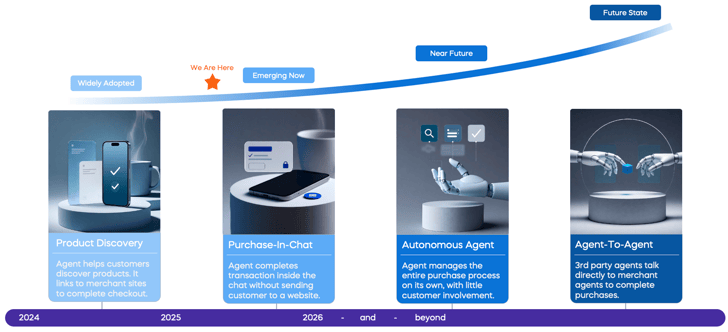
The demos at Google's I/O 2025 conference showed Gemini not just finding information but acting on it — purchasing at a later time, without human intervention, based on pre-set conditions. This is the "human-not-present" scenario, and it's built on a new technological foundation.
Two concrete milestones provide evidence that "purchase in chat" is emerging now:
- Perplexity's Shop like a Pro (Nov 2024): introduced in‑app purchase for select products.
- ChatGPT's Instant Checkout Phase 1 (Sep 2025): the feature launched, built on the Agentic Commerce Protocol (ACP) co-developed with Stripe, and rolled out to merchants on Etsy and Shopify.
- ChatGPT's Instant Checkout Phase 2 (Oct 2025): the ecosystem expanded massively when PayPal adopted the same protocol, announcing it would power Instant Checkout with its wallet and bring its global network of tens of millions of merchants into ChatGPT.
The trillion-dollar shift: why it matters now
The narrative is solidifying and the scale is staggering: agentic commerce is the next "trillion-dollar shift," according to Salesforce and McKinsey. This isn't just a new channel — it's a fundamental restructuring of value capture.
This trend poses an existential challenge to merchants. As AI agents manage end-to-end purchasing, they bypass websites, creating massive disintermediation risk. With agents as the new customer entry point, traditional direct traffic, merchant visibility, and access to customer data will deteriorate.
Marketing, branding, and UX — historically focused on human psychology — must be re-evaluated. Agents make decisions differently, prioritizing price and hard specs over brand affinity. This shifts the competitive advantage to merchants who can meet machine-optimized logic. The question becomes, "how do you market to a machine?" The answer likely involves text-only, machine-readable, and API-accessible data rather than traditional visual design.
While many customers will still prefer the human shopping experience, the strategic challenge is preparing to serve both people and algorithms.
The two fronts of agentic commere: B2C personal concierge and B2B procurement automation
This transformation is happening on two distinct fronts: B2C and B2B.
- B2C - Personal Shopping Concierge: For consumers, agents act as personal assistants for complex, multi-step tasks. Instead of a simple query ("buy a VPN"), the agent manages the entire journey ("I want to watch my favorite show when I travel abroad"). It anticipates the need for a VPN to access the show in the home country, compares options, negotiates, and executes transactions.
- B2B - High-Speed, Auditable Procurement Automation: For enterprises, agents can automate the high-friction, manual processes of B2B procurement: lengthy RFPs, email chains, and legal reviews. Tools are already emerging (e.g., Pactum, ZipHQ) to manage these workflows. The end-state is high-speed, auditable, and agent-to-agent interactions that are autonomous.
One of the most intriguing developments is the emergence of AI-to-AI negotiations, which are already happening in B2B procurement.
The plumbing for trust
Today's payment infrastructure was built for humans clicking "buy." It breaks down when an AI agent is the customer, raising critical questions:
- Agentic User Experience: What is the best user experience for an agentic customer?
- Authorization: How does a merchant know the human user actually approved this purchase?
- Accountability: If the agent hallucinates and buys the wrong item, who is liable? The human user? The merchant? The Agent provider?
User experience will be dominated by interfaces designed for systems-to-systems communication. The Authorization and Accountability is the trust gap that new protocols are designed to solve.
Technology infrastructure and protocols
(For technical readers. If you're not technical, skip ahead to "The path forward.")
At a glance: the trust stack for agentic commerce.
- Payment network tokenization keeps raw PANs (e.g., credit card numbers) out of the agent's flow. Networks replace card numbers with network tokens, so agents never store, process, or transmit cardholder data, shrinking the PCI DSS (Payment Card Industry Data Security Standard) scope for the agent layer. Merchants and processors still hold the core compliance duties.
- Verifiable Credentials (VCs) provide cryptographic proof of user intent and authorization. In modern agent flows, these credentials are attached to actions the agent takes, creating a verifiable record of consent.
- Protocols coordinate consent, ordering, and interoperability across ecosystems: AP2 (payments trust & audit), ACP (today: order + checkout inside ChatGPT), MCP (standard for connecting agents to tools/data), and A2A (agents coordinating with other agents).
Mandates (the cryptographic authorizations agents rely on)

Mandates are expressed as verifiable credentials, providing a cryptographic audit trail for consent, presence, and dispute resolution.
Protocols you should know:
- AP2 - Agent Payments Protocol (Google Cloud with broad ecosystem support): Open, ecosystem standard that establishes verifiable consent, user-presence semantics, and a cryptographic audit trail for agent-led payments. Initial focus is on card ("pull”) payments, with broader rails on the roadmap. Treat AP2 as the north star for authorization posture and disputes.
- ACP - Agentic Commerce Protocol (OpenAI with Stripe; now adopted by PayPal): Standard for buy-in-chat flows. As of Oct. 28, 2025, PayPal has adopted ACP; PayPal wallet works with Instant Checkout and PayPal will handle delegated card processing. In 2026, PayPal’s ACP server will onboard catalogs for tens of millions of merchants into ChatGPT commerce without one-off integrations.
- MCP - Model Context Protocol: A standard way for agents to access tools, data, and workflows — think of it as the interconnect layer so agents can call what they need safely. Use it to expose your catalog, pricing, CRM, and internal tools in a consistent, auditable way.
- A2A - Agent-to-Agent Protocol: Interop layer for agents coordinating across vendors (e.g., discovery, negotiation, task handoff). Expect payment steps to be handled via AP2 within multi-agent flows.
What's still maturing (October 2025)
- Subscriptions & recurring billing: standardized recurring/subscription patterns are still evolving; expect custom handling or PSP-specific flows in the near term.
- Feature breadth in chat checkouts: many implementations support single-item purchases first; multi-item carts and complex promotions are rolling out incrementally.
- Payment-method coverage: card-first historically, wallet support has just arrived (PayPal in ChatGPT) with broader rails still on the roadmap.
Important note: Payment and agentic protocols remain nascent. Many do not yet fully support recurring payments or complex subscription lifecycles — a staple of SaaS and modern e-commerce. Plan for transitional patterns and PSP-specific adaptations.
The path forward: practical implementation playbook
We are in a phase of rapid, defining experimentation. While the final shape of agentic commerce is uncertain, its trajectory is not. ChatGPT serves over 800 million weekly users; Google's AI Overviews reach 1.5 billion monthly. Commerce is flowing through AI channels now, not in some distant future.
Adapting to this paradigm shift is not a mere user interface refresh; it is a fundamental restructuring of how products are discovered and how buying decisions are made. The path forward begins with these five foundational steps:
- Audit your technical foundation: The immediate, non-negotiable prerequisite is payment tokenization. Verify that your payment rails and commerce partners have fully implemented this standard, as it is the foundation for all secure agentic transactions. Furthermore, inquire about their roadmap for adopting emerging protocols such as AP2, ACP, and the "Know Your Agent" (KYA) standards.
- Re-evaluate compliance and risk: The legal and regulatory landscape for AI is evolving rapidly. Accountability in an agentic world demands transparent governance and fully auditable logs (e.g., mandates, presence, constraints, approvals). Ensure your commerce partners and internal teams have a robust framework for compliance and risk mitigation, and are ready to handle the new liabilities introduced by autonomous commerce agents.
- Adopt an "agent-first" content strategy (your new primary customer is an algorithm): Agents do not respond to glossy visuals or emotional marketing copy — they parse structured data. Add a content strategy that shifts from human-centric persuasion to providing rich, machine-readable, and explicit information about your products, services, and policies.
- A/B Test the Agent Experience (AX): Begin experimenting immediately. Develop variants of agent-readable content and test conversation rates. Treat the "agent experience" (AX) with the same rigor and importance as your "customer experience" (CX) — it will soon be just as critical to your success.
- Define your agent autonomy strategy: Connect your strategy to the principles used in high-stakes environments. Using the "autonomy slider" concept (as discussed in a previous article), start by deploying agents in "collaborator" (L2) or "consultant" (L3) roles. This ensures a human remains in the loop for all consequential actions. Treat agent autonomy as a privilege to be earned: never widen autonomy without verifiable evidence of safety and reliability.
Want to read the first blog of the series? Click here.