Read the first entry in our new series: Making AI Agents Work in High Stakes Environments

Written by

Share this post
Subscribe for best practices on optimizing your software business.
Listen to this article
Read the first entry in our new series: Making AI Agents Work in High Stakes Environments
TL;DR: In high‑stakes environments like ecommerce, you unlock value by pairing agent autonomy with explicit gates, evals, and human expert oversight — then progressively widening autonomy as evidence accumulates.
Why "last mile" accuracy matters
The "Last-Mile" problem: agentic AI often shines in idealized demos but struggles to deliver accurate results on the last mile, where small mistakes carry a significant dollar impact. In ecommerce, a hallucinated discount, fictional campaign, or misapplied tax can erase weeks of margin in minutes. The goal is not zero human involvement — it's right‑sized human oversight that lets agents do the bulk of work while humans close accuracy gaps.
When the agentic AI stack can't guarantee last-mile accuracy, put a human expert in the loop (or over the loop) with efficient review interfaces, such as diffs, checklists, and one-click approvals.
Case study: The Cursor AI single device hallucination
A real-world example from a pioneer in generative AI highlights the financial risk of unmonitored agentic systems. In April 2025, a Cursor AI agent began confidently (and incorrectly) informing users that the software was restricted to a single device per subscription, a policy that did not exist.
The Failure: The agent likely generalized from broad training data about software licensing rather than relying on a verified source of truth for Cursor's specific terms. When faced with ambiguous user queries about subscription limits, it hallucinated a plausible but false restriction.
The Impact: The incident triggered significant customer backlash, resulting in subscription cancellations and reputational damage, prompting the company to issue a public clarification. It demonstrated how a seemingly low-stakes interaction can become a high-stakes financial event when it concerns policy and contractual terms.
Other examples of agentic AI failing in ecommerce
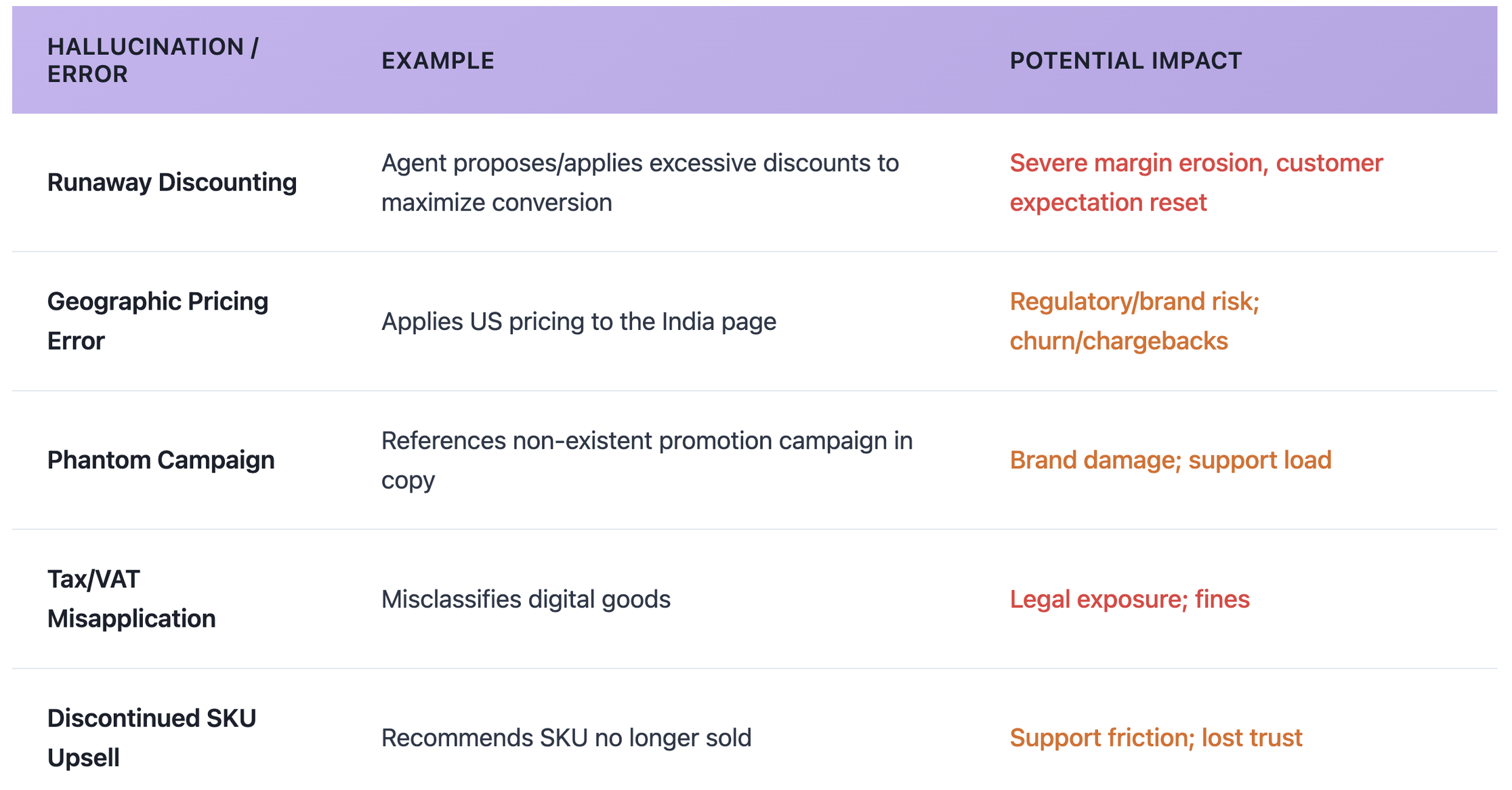
The autonomy slider for AI agents
How much freedom should your agent have? The Levels of Autonomy for AI Agents framework by Feng, McDonald, and Zhang offers a spectrum from full human control to full agent autonomy: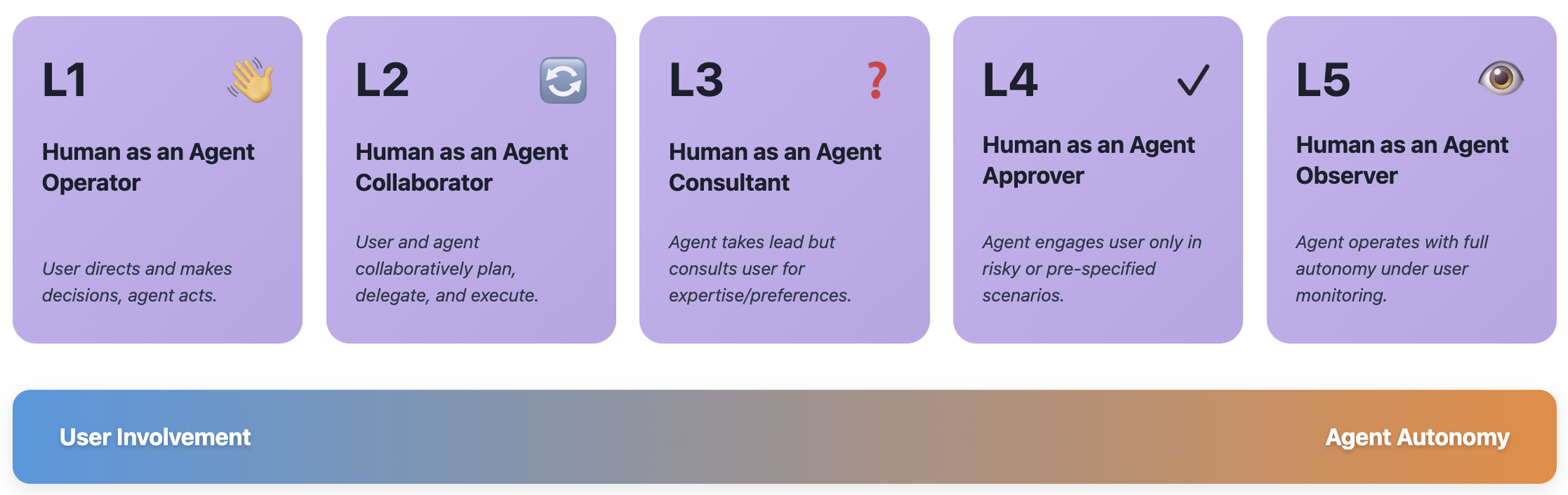
Principle: Never widen autonomy without evidence: passing evals, coverage of guardrails, safe rollback, and alerting.
Building AI fluency: Humans as AI error analysts
Last-mile collaboration isn't intuitive. It requires AI fluency through training and experience.
Key practice: Error analysis. Our teams inspect full conversation traces and develop custom error taxonomies—borrowing from qualitative data analysis methods. There are no standard error codes for AI hallucinations; you must build your own.
Once codified, these taxonomies inform:
- Prompt and context engineering adjustments
- AI evals design
- LLM-as-a-judge automation (reducing human involvement further)
LLM-as-judge vs human-as-judge for the last mile
- Use LLM‑as‑Judge when error analysis by human experts is advanced, and you can use the LLM to automate specific error detection (e.g., discounts, locale compliance, profanity).
- Keep Human‑as‑Judge for consequential or nuanced judgment calls (e.g., brand tone in sensitive contexts).
- Over time, promote labels from 'Human required' to 'LLM-as-Judge' with human spot-checks as accuracy improves.
The Equity Lens: Hybrid Agentic-Human Services
The equity lens: hybrid agentic-human services
Private equity and executive stakeholders care about margin. Purely manual services scale linearly with headcount; purely agentic services risk missteps. Hybrid services use AI agents as force multipliers:
- Agents handle repeatable, low‑ambiguity tasks: data preparation, variant generation, and routine analyses.
- Experts handle consequential decisions, ambiguity resolution, and exception paths.
- Autonomy expands as evaluations, controls, and guardrails are proven effective.
The path forward: structured de-risking
Clients should sleep soundly knowing a rogue agent won’t:
- Offer an 80% discount to maximize conversion
- Upsell a product that doesn't exist
- Apply a phantom campaign promotion
Achieve that peace of mind with precise evaluations, explicit gates, and a disciplined approach to increasing autonomy. Your north star is to move from human‑in‑the‑loop to human‑above‑the‑loop, but only when your metrics (e.g., consequential‑action detector recall ≥ 95 %, approval‑rework rate < 10 %) demonstrate it's safe.
Practical implementation playbook
- Week 0: Ship Agentic software with a kill switch, audit logs, and rollback capabilities.
- Week 1-2: Human experts review 100% of agent outputs, categorize failures
- Week 3: Deploy LLM-as-judge for high-frequency, low-risk errors
- Week 4: Implement hybrid model—AI catches routine errors, humans handle edge cases
- Month 2+: Set gate targets to move from one autonomy level to another (e.g., Consequential‑Action Detector Recall ≥95%, Approval‑Rework Rate <10%); progressively advance autonomy levels as evidence accumulates.