Kyle Poyar on the economics behind different routes to market, where costs hide, and how vendors can match transactions to the right buying path.
We sat down with Kyle Poyar, creator of the popular newsletter/podcast Growth Unhinged, to get his take on Cleverbridge’s new research report from 1,159 B2B software sellers and buyers: The Cost of Selling Software.
Kyle discusses why software companies need to look beyond customer acquisition cost, how pricing and channel complexity shape GTM economics, and why routine transactions represent an overlooked opportunity to improve efficiency.
What stood out in the benchmark
Dan: After reading through the benchmark report, what stood out to you most? What felt consistent with what you’re seeing across software go-to-market, and what felt new or under-discussed?
Kyle: There’s a real efficiency crisis among software companies. CAC payback periods have exploded. Even public companies see a 44-month CAC payback. Gross margins are coming down as companies add AI capabilities with real token costs. And there’s less expansion revenue to be found.
Companies are responding by taking a “select all that apply” approach to their routes to market. It doesn’t surprise me that so many companies are generating revenue from three to five channels, including direct sales, self-serve, cloud marketplaces, channel partners, and app stores.
What stands out about the report is that there’s a clear path to greater efficiency that’s hiding in plain sight. Renewals and routine transactions represent a massive share of revenue, yet still tend to cost $1,000 or more to process. This doesn’t get much airtime since so much attention is paid to acquiring net-new customers.
Channel mix vs. GTM efficiency
Dan: When software companies add more routes to market — sales-led motions, partners, marketplaces, owned digital channels, and more — what tends to improve, and what tends to get harder? Where are you seeing channel breadth create more flexibility, and where is it creating new complexity?
Kyle: What improves is the buyer experience. You meet buyers where they want to transact: through existing partner relationships, committed marketplace spend, or a fast self-serve experience. This increases the addressable market and can compress sales cycles.
But each new route to market adds operational complexity and increases the risk of channel conflict. A sales rep might be assigned a deal, but the prospect wants to buy through self-serve. This is great for the prospect because they have choice. It can be a potential headache for the CRO.
One of the biggest battlegrounds is pricing. Self-serve channels and marketplaces require a high degree of pricing transparency, and the customer expects the published price to be the lowest price. Direct sales teams prefer custom pricing with a high degree of discounting flexibility. How do you optimize for one route to market without hurting another?
Route-to-market economics
Dan: The benchmark shows that each route to market can consume a meaningful share of deal value. Why are route-to-market economics becoming more important now? And how should a software company with $5 million in annual revenue think about it differently from one with $500 million?
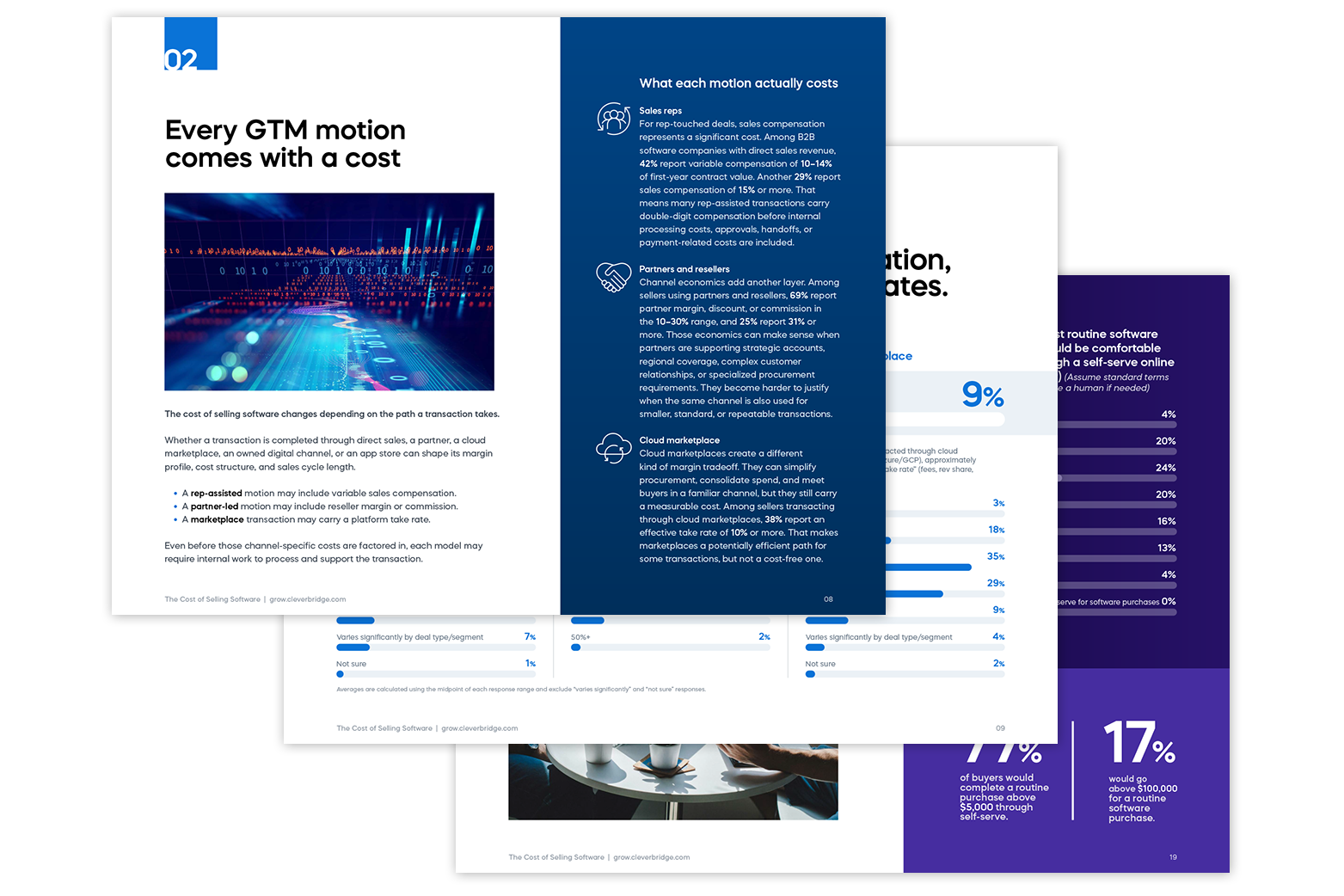
Kyle: The economics of each route are striking: 71% of software companies with direct sales report paying 10% or more of first-year contract value in variable compensation, 69% using partners report commissions worth 10-30% of deal value, and 38% using marketplaces report an effective take rate of 10% or more.
A $5 million ARR company can probably optimize these economics later. What matters at this stage is finding repeatability and scaling new customer acquisition. For a $500 million ARR company, though, shifting the channel mix, especially for renewals, could save tens of millions of dollars each year. This is money that could get redeployed elsewhere: AI investments, marketing spend, product launches, you name it.
Cost-to-serve for routine transactions
Dan: More than half of sellers report spending at least $1,000 internally to process a typical routine transaction — a low-complexity purchase with standard terms — and more than one-third spend six hours or more. Those figures are not dramatically lower than the costs associated with complex transactions. What does that reveal about how companies currently measure GTM efficiency, and where those costs may be hiding?
Kyle: It reveals that we measure acquisition efficiency, not transaction efficiency. CAC payback gets a board meeting slide. Cost-per-renewal isn’t measured anywhere, and most companies don’t have a team that’s responsible for it. Only 40% of direct-sales sellers have a dedicated owner for routine renewals and low-complexity expansions, according to the research.
Buyer expectations for software purchasing
Dan: One of the clearest buyer-side findings is that 66% of buyers would complete upgrades or plan changes through self-serve, but only 34% have done so in the past year. What do you think is preventing buyer willingness from translating into greater adoption?
Kyle: According to the study, 93% of buyers would use self-serve checkout for routine purchases if it were available and allowed. The appetite for self-serve is real.
Part of the issue is pricing design. I expected to see a shift toward pricing transparency, and this shift isn’t playing out. Pricing models are getting more complex, not less: hybrid models, credits, outcome-based pricing. When complexity goes up, buyers are forced to talk to a human even when they’d rather not.
What’s fascinating is that I believe AI engines like ChatGPT and Claude will force companies to introduce pricing transparency, whether they’re ready or not. Buyers are already turning to LLMs to recommend products and understand pricing. Opaque pricing could keep companies off the shortlist entirely.
Where human involvement creates value
Dan: If the answer is not “everything self-serve” or “everything sales-led,” companies need a way to decide which path each transaction should follow. Where does human involvement create the most value, and what factors should determine whether a purchase goes through sales, a partner, a marketplace, or an owned digital channel?
Kyle: Deal size used to predict when sales got involved. Now even a free trial could require a security and compliance review. At the same time, some buyers are comfortable spending thousands of dollars per month without ever talking to someone.
The insights from the report match what I’ve seen in practice. Buyers want to talk to a human for large multi-year agreements, security and compliance reviews, procurement exceptions, complex configurations, and custom pricing. Humans create value where judgment, negotiation, and multi-stakeholder navigation are required — not when someone needs three more seats.
The operating-model challenge
Dan: In the report, 96% of sellers agree that routine transactions will increasingly shift to self-serve, yet only 17% say they already have a self-serve path in place at scale. What explains that gap between belief and execution?
Kyle: Look at the objections sellers cite: security and fraud, customer experience and brand control, integration complexity, pricing governance, and internal sales pushback.
Those are all solvable, but solving them requires a clear owner and direction from the top.
The first internal conversation
Dan: If a software company wanted to act on the data in this report, where should they start? Which teams need to be involved, and how should leaders measure whether the changes are working?
Kyle: Start with a transaction-mix audit. Separate purchases into routine vs. complex across net-new deals, renewals, expansions, and upgrades. Look at how many transactions and how much revenue falls in each bucket. Then figure out how much time and cost goes into each. This will help educate the leadership team about the opportunity and create a business case for change.
From there, pilot a lower-cost motion for high-volume, routine transactions — likely an SMB renewal segment or a seat upgrade flow. Measure the results across multiple dimensions: renewal rate, upgrade rate, cost-per-transaction, cash collection, and forecast accuracy. Bring in Sales, Customer Success, Finance, and RevOps to review the results.